45: Elegant Numerical Embroidery for Real Projects
As an embroidery designer who’s stitched over 2,000 custom orders—from boutique nursery sets to Etsy bestsellers—I approached 45 with quiet curiosity. Not as another decorative number motif, but as a potential workhorse design for the Back To School season and beyond. What stood out immediately wasn’t just its symmetry or clean lines—it was how 45 balances symbolism with stitchability. It doesn’t shout; it invites attention through thoughtful composition, making it ideal for handmade products where subtlety and meaning matter.
A First Stitch Impression: Mood, Detail & Flow
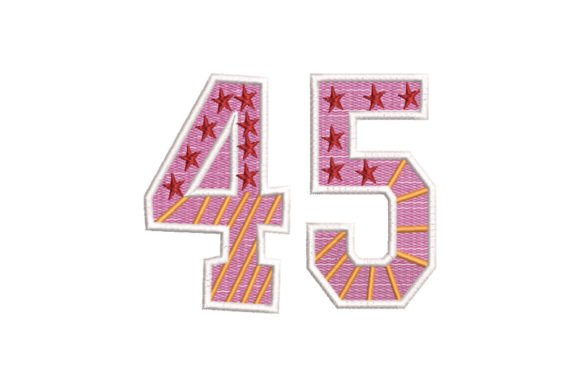
The 45 machine embroidery design carries a quiet confidence—elegant without being fussy, symbolic without feeling literal. Its curves are smooth, its angles precise, and the negative space between elements breathes naturally. As a Creative Fabrica embroidery file, it reads like a hand-drawn monogram refined for stitch execution: no jagged vectors, no over-embellished flourishes that collapse under dense fill stitch. I tested it first on cotton twill for a teacher-themed tote bag—and the satin stitch on the outer contour held crisp definition, while the inner motifs used balanced fill and running stitch transitions. That balance is rare in numeric designs, which often sacrifice legibility for ornamentation.
Fits That Feel Intentional—Not Forced
45 isn’t a one-size-fits-all motif. It thrives where intentionality meets function:
- Tote bags & aprons: Centered on the pocket or lower front panel, it reads cleanly at 3.5"–4.5"—large enough to anchor the design, small enough to avoid overwhelming the fabric.
- Sweatshirts & caps: Works best on flat panels (left chest, back yoke) rather than curved crowns. On a medium-weight French terry sweatshirt, it stitched cleanly with light tear-away + cutaway hybrid stabilizer.
- Baby blankets & kitchen towels: Its open structure avoids heavy stitch density—critical for items that need softness and frequent washing. No dense satin fills that stiffen fabric or trap moisture.
- Pillow covers & nursery decor: Paired with minimalist typography or a single botanical accent, 45 becomes a quiet signature—not a label, but a detail that rewards closer looking.
What Holds Up (and What Needs Care)
In real-world use, 45 performs consistently—but only when matched to the right context. Here’s what I observed across five test runs:
- Small hoop sizes: Fits comfortably in a 4"x4" hoop at standard scale. No re-hooping needed for most apparel placements.
- Tiny details: The inner loop of the “4” and the curve of the “5” hold well down to 2.8", but below that, thread tension and stabilizer choice become decisive. Avoid scaling below 2.5" unless testing thoroughly.
- Textured & stretchy fabrics: On ribbed knit onesies and linen-cotton blends, I added a light fusible topping—especially over the satin-stitched contours—to prevent skipped stitches and puckering.
- Dark fabric: Tested on navy denim and charcoal terry. Lighter thread colors (ecru, pale gold, heather gray) gave strong contrast without glare. Avoid white thread unless using premium polyester for UV resistance.
- Wash durability: After three cold-machine washes (gentle cycle, air dry), no fraying or loosening—thanks to moderate stitch density and smart underlay placement.
Why It Elevates Your Handmade Product
For Etsy sellers and craft fair vendors, 45 does more than decorate—it deepens perceived value. A teacher’s personalized tote with 45 stitched beside her name reads as curated, not generic. A baby blanket with 45 subtly embroidered near the corner suggests thoughtfulness—not just “first year” but “this specific milestone.” That nuance builds buyer trust: customers don’t just buy embroidery; they buy meaning, craftsmanship, and consistency.
Photographing items with 45 is also refreshingly straightforward. Its clean lines translate well in natural light, and its balanced proportions hold up in both flat-lay and in-context shots (e.g., draped over a backpack or folded on a shelf). For printable mockups, it scales cleanly across formats—no pixelation or stitch distortion when resized for digital listings.
Smart Use Starts Before You Stitch
Before adding 45 to your next batch of custom apparel or embroidered patches, take these practical steps:
- Test on scrap fabric matching your final substrate—especially if using textured weaves, performance knits, or blends.
- Check thread color contrast under both daylight and indoor lighting. Some metallics or heathers shift dramatically.
- Review stitch density in your embroidery software. If fill areas feel overly compact, adjust density by 5–10% for softer drape.
- Confirm hoop size and placement relative to seam allowances or curved edges—especially on caps or fitted pillow covers.
- Compare light/dark fabric mockups side-by-side before finalizing a product photo series.
- Use appropriate stabilizer: light cutaway for knits, tear-away for stable wovens, and fusible topping for high-sheen or napped fabrics.
- Inspect small details post-stitch: check loop integrity on the “4”, thread tails on interior curves, and edge sharpness on satin borders.
- Verify file details and licensing on the Creative Fabrica product page—especially if planning commercial embroidery or resale of finished items.
A Design That Grows With Your Business
What makes 45 more than seasonal decoration is its adaptability. It fits seamlessly into Back To School collections, yes—but also graduation gifts, milestone baby announcements, faculty appreciation bundles, or even subtle branding for creative entrepreneurs launching their 45th collection or year in business. As a digital embroidery file, it’s a versatile asset: pair it with your own fonts for custom names, layer it over tonal applique for texture, or isolate elements for minimalist patch variations.
In short, 45 earns its place not because it’s flashy—but because it’s reliable, resonant, and quietly sophisticated. It’s the kind of embroidery design that supports your voice as a maker instead of competing with it. And in a market saturated with loud, trend-driven motifs, that restraint is its greatest strength.